More Trial Data With Explanatory Photos
Max Henderson May 26, 2008
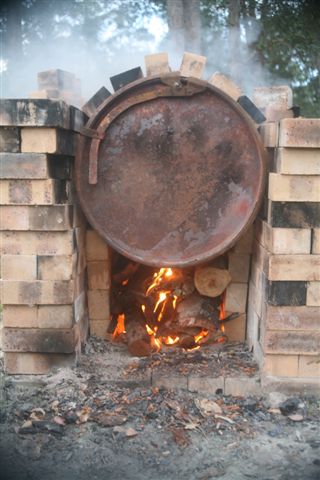
<Kiln External
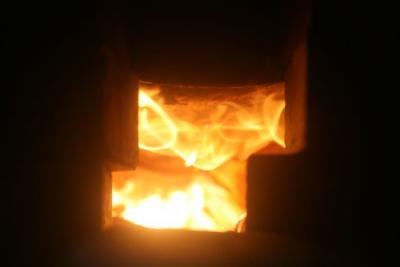
<Kiln Fire Under Drum
First is from the front of the kiln just after the fire was lit and before bricks were added across the front. The drum lid is held in place with an over-centre clamp. The side and rear bricks have been moved in to touch the drum to improve insulation.
Second is through a hole in the front brickwork, shortly after the gas started to flow. There are two fire layers – at the base of the fireplace, and an upper fire just under the drum. This is the gas exiting from the holes in the base of the drum, igniting, and then curling upwards.
From this weekend:
Assume that the drum is set up in the brick kiln
Equipment: chainsaw, axe and wheelbarrow
Old and dry fallen timber is available 30 metres from trial site.
Chainsaw and split 110 kg hardwood for drum load
Ditto 40kg for fuelwood
Load drum
Gather twigs and small dry branches, load fireplace with these and the 40kg wood
Seal drum and light fire.
Time = 45 minutes
Char output = 29kg.
Rough cost, including chainsaw fuel and some provision for wear and tear, and (say) $A20/hr for labour, then maybe $18 for 29kg char. If I could get $1/kg for char chunks for BBQ’s, and keep the fines for the soil, I’d be about square. Packaged charcoal (in briquettes with sawdust and other stuff added) retails in Oz for around $2/kg.
I still maintain and will get around to proving it some time, that if surplus gas could be withdrawn and stored, and then used for the fire, the 40kg of firewood would not be necessary. The level of the flames from the gas escaping through the poor drum seal demonstrates this, plus there are opportunities to improve on my rudimentary house brick insulation.
An observation is that smaller pieces of wood are more efficient. And the smaller the pieces the more mass that can be loaded into the drum. I’ve had successful chars with hardwood up to 20cm diameter, but I’ve also had some cases where the centres weren’t fully charred. A compromise is maximum thicknesses around 8-10cm.
I have to admit that I remain in awe of the whole process. Normally I start the fire around 17:00. It’s autumn here and dark and increasingly chilly by 18:00, which is around when the gas starts to flow. There’s a gentle whistle to start with, and within 15 or 20 minutes this becomes a muted roar, the flames creep around the gap between the drum and the bricks and filter through the bricks on top of the drum, the top bricks begin to glow red, and I sit (with glass in hand) and ponder on the vast amount of energy being released from 110kg of wood, and which lasts for several hours.
My latest garden trial includes basil, broad beans, corn, capsicum, egg plant and parsley in the trial plots. The beds were made on top of untilled soil, which is compacted and so hard that in another bed I had to use a mattock to break it up. The mix in the main bed includes mulch, cocopeat, some worm compost and char. This has now been established for 6 weeks, and not only is it easy to dig down to the base by hand, the first inch or so of soil under the bed is friable. The bed without the worm compost and char is also friable but the soil layer underneath is still rock-hard. The colour, vigour and size of the plants in the bed with char are substantially ahead of the control bed. Also, we’ve had no rain for 2 months and all plants are only watered once/week. There’s something going on here that I don’t fully understand, but I’m not complaining.
Max H
- 1682 reads
Digg
StumbleUpon
Google
Technorati

Comments
Post new comment