Cundall
Peter Cundall: Slow Burning Solution
In Organic Gardener (Australia), September/October 2008, Courtesy Ron Larson and Albert Bates

Using Biochar
Excerpt:
"How can we use biochar?
That’s where we come in. I’m just one of many gardeners throughout the world beginning to experiment and study the way charcoal, mixed with added minerals – such as forms of decomposed organic matter and other natural nutrients – can be used in suburban food gardens.
Already I have managed to achieve surprising results. For a start, it has become clear that less water and fewer fertilisers are needed in soils enriched with biochar. Acidic soils benefit by being sweetened, earthworm populations increase and bacteria land other forms of life in the soil become more complex and balanced. There is some evidence that methane gas emissions from the soil are also reduced, as well as those of nitrous oxide, a deadly greenhouse gas that is 310 times more destructive to the atmosphere than carbon dioxide.
In our Tasmanian garden, this soil treatment has already produced better, healthier growth and plants that appear to be resistant to diseases and suffer fewer pest attacks.
First, an obvious question: where can gardeners get biochar? How can home gardeners make it, without causing atmospheric pollution? Already a few (though not many) garden centres are selling pulverised charcoal – mainly for orchid growers. It can be expensive, but I believe that in the near future an increased demand for biochar will make it an easily available, cheap soil additive.
How Can we Produce It?
Charcoal can be made from any form of so-called waste organic matter. Our rubbish tips are full of the stuff. Major sources include countless millions of tonnes of factory and farm waste such as animal droppings, sugarcane trash and straw. Forestry and sawmill operations produce great piles of organic debris, much of which is
burnt on site, causing serious pollution and health problems. Deliberately-lit forest burns are a still a major source of greenhouse gas emissions.
Modern techniques of creating huge amounts of biochar by heating organic matter in an almost oxygen-free environment (without pollution) have now been developed and are already in use in many countries. Combustible gases produced during these processes
are carefully drawn off and stored or put to use. Clearly, environmentally-sensible
methods of manufacturing biochar are both possible and beneficial.
Living in a cool climate has helped me make my own charcoal. We use a slow-combustion wood-fired heater and cooker. This flat-top stove is big, black, ugly and built like a Centurion tank. When I bought it 25 years ago, it had a label attached which claimed that it was ‘Guaranteed for Life’.
We can insert two giant logs in it and, by virtually cutting off the air supply, cause the wood to burn slowly while still throwing out heat for the best part of a day. A double-burner ensures no combustible gases escape,and there is hardly any smoke.
It enables us to heat our home and, at the same time, slow-cook casseroles, soups and other food. After about 12 hours, even very large logs have gradually been turned into huge chunks of brittle charcoal that can be easily and safely raked out.
Making biochar mix
After being cooled by being dumped on clumps of perennial weeds and then wetted, the charcoal lumps are ready for crushing. I add wet coco-peat to keep the moisture in and help absorb dust particles. Some gardeners recommend crushing charcoal chunks by placing them in a strong bucket and bashing them. Unfortunately, most buckets
aren’t made to take this type of battering and will quickly fall apart.
An easier, more reliable, method is to use two hefty firewood logs, one of them with a fairly flat surface. Here’s how to do it:
• Spread a plastic sheet over an area of level ground with the flat piece of wood laid on top, near the centre.
• Thickly spread the charcoal pieces over the flat top of the wood and give them
a good thumping using the butt of the second log. It takes only minutes to make half-a-bucket of crushed charcoal.
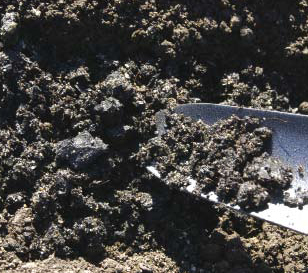
• Into this, mix one-part each of coarse sand and garden (or potting) soil to double the bulk. Where leafy or other nitrogen-hungry vegetables are to be grown, I also add 2 litres of water into which one tablespoonful of fish emulsion and another of seaweed concentrate is dissolved.
• When this is poured into the charcoal mix, a stiff black slurry, thickly dotted
with fragments of charcoal is created. It can be stored or used straight away.
Other uses
Biochar can also be used as a surface mulch, where the black colour helps the soil to warm more rapidly in early spring. It can also be applied as a side dressing alongside growing plants. I prefer to bury it prior to sowing seed or planting seedlings. If used to grow potatoes, place the seed tubers along the base of a 20cm-deep trench and cover with a thin layer of soil. Then spread a 5cm-deep and wide layer of biochar over the top and back fill with soil.
Does it work?
The most dramatic results I’ve had so far are with sweet corn. I created two
15cm-deep grooves in the soil, then half-filled them with biochar mix and covered this with soil. I sowed the sweet corn seeds just beneath the surface, but in contact with the layer of biochar. I also sowed two other rows of sweet corn seed, this time without biochar, using only pulverised sheep and poultry manure mixed with blood and bone.
Two weeks later the differences were already obvious. The biochar seedlings were up and moving fast, while the rows of untreated seeds showed erratic germination. As the plants grew, I watered all of them and later mulched them in the same way. However, the biochar corn grew with extraordinary strength and final yields were at least
twice that of the untreated rows. Some biochar-treated plants actually bore up
to six large cobs each, because even the side-shoots (normally non-productive)
both carried two cobs each.
A similar biochar experiment with tomato seedlings showed little difference in yield, although treated plants had a slightly healthier leaf colour and showed no signs of disease."
See article attached.
Organic Gardener, New South Wales. http://www.abc.net.au/gardening/features/organic_gardener.htm
For more information about Peter Cundall see:
Peter Cundall (Wikipaedia)
Peter Cundall on Gardening Australia ABC Website
- Login or register to post comments
- 717 reads
Digg
StumbleUpon
Google
Technorati