How to Make Biochar ( Charcoal from Biomass)
Making Charcoal
- A handy kiln for making charcoal from urban leaf litter, Appropriate Rural Technology Institute (ARTI), Pune, India www.arti-india.org
- Briquetted Charcoal from Sugarcane Trash
Folke Gunther
- Simple Charcoal Kiln at Home
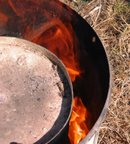
Simple Charcoal Kiln
From Mark Coldiron, TxBeeFarmer, July 2008: Good "how to" charcoal making 4 part video.
- part 1 http://video.google.com/videoplay?docid=5122206324434669401&ei=&hl=en
- part 2 http://video.google.com/videoplay?docid=-4228528283369918059&ei=&hl=en
- part 3 http://video.google.com/videoplay?docid=-882323473764674138&ei=&hl=en
- part 4 http://video.google.com/videoplay?docid=1880524045220008547&ei=&hl=en
Folke Gunther May 2008 Simple Method of Charcoal Produciton
Links March 2008
- Making Charcoal Dr. N. Sai Bhaskhar Reddy, India
- Making Charcoal in A Drum Gary Gilmore, DNRC Forester
- Charcoal from Smallwood Tom Hammet, Virginia tech
- Adam Retort (ICPS) Chris Adam, Germany 2007
- Charcoal Making at Home Robert Lea, Fayaetteville, Arkansas
- Fuel for the Fires Charcoal Making in the 19th Centry
- Dave's How to Make Charcoal Notes Kiln
- Industrial charcoal making FAO FORESTRY PAPER 63 1985
- Simple technologies for charcoal making FAO FORESTRY PAPER 41 1987
- Making Lump Charcoal
- How to Make a Small Charcoal Kiln
- Charocal Production Terra Preta Website
- Charcoal Production Biomass Cooking Stoves website
- Charcoal and Wood Preservation ZERI
- How to Make Your Own Lump Charcoal Naked Whiz 2004
- How to Make Charcoal WikiHow
- CHarcoal Wikipedia
- How to Make Charcoal: The Survival Forum Making Charcoal Hypography Science Forum
- How to make bamboo charcoal in a simple way Junji Takano Pyro-Energen Earth Kilns
- Chapter 5 Earth Pits for Charcoal Making FAO
- Chapter 6 Making Charcoal in Earth Mounds FAO Glossary
- Glossary of Charcoaling Terms The Wildlife Trusts, Cornwall, UK
- 48995 reads

Comments
accumulate 8-10 tonnes of
accumulate 8-10 tonnes of charcoal!good information though.
joe mercer| my personal weblog|easy calm| New York City
Campfire charcoal
Hello All,
I wish to share this with the you.
I like to cooking in a cast Iron Dutch Oven in campfire coals ever since being taught how in the Boy Scouts for the past 50 years. Since the weather in New England tends to change by the minute,...it rains a lot. As a result I have accumalated 8-10 tons of campfire charcoal, which was stored in a large mound, and subjected to New England weather over the past 12+ years.
When The benefits of Terra Preta was discovered about 2 years ago, the charcoal pile was incorporated into the 2 arce garden,..... and seeds were planted. The garden was neglected for 1 1/2 months due to out of the country commitments. We expected a disaster,......
When we returned we found a luxurious crop of corn, beans, squash, cucumbers, radishes, and of course weeds. Yeilds were a least 2X,...and the flavor was so good that we found it easy to eat as a vegan. Makes you wish that you could grow all year long.
The soil was easy to work by hand, the root structure was impressive, and the quantity of earthworms phenominal.
We plan to increase the size of the garden, and incororate more bio-char.
We are working with New England Small Farm institute, Step it up- Belchertown with inputs from Dr. Ogawa, Tom Miles , David Yarrow, Doug Claton,Danny Day, et al. on doing a Bio-char studies as a soil amendment in a larger study.
Dr. Julie Majors ( IBI ), "A Guide to conducting Bio-char Trials", was used as our basic plan of action,....
This was presented to our regulatory Dept. Of Environmental Protection, and was recieved favorably.
We especially liked the Quick Tests for bio-char suitablity which involved seed germination rates and Earthworm avoidance tests. This allows rapid screaning of bio-chars for suitabilty as a soil amendment. It has been suggested that the pH of the bio-char be adjusted to a slightly acidic to neutral ( 6.0 to 7.5 ) usiing vinegar, humic or carbonic acids before usiing the quick tests. Sulfuric and phosphoric acids would be more effective, but the additional sulfur and phosphorus may cause unforeseen fertilizer effects.
Another good resource was " Biochar, Climate Change and soil: A reveiw to guide future research" by Sohi, Capel, Krull, Bol.
If the group is interested,.....we can keep you posted.
Best regards,
Ted S. Wysocki Jr.
Post new comment