Making Charcoal

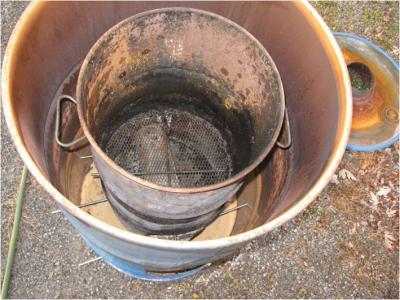
Simple charcoal kiln

Simple charcoal kiln
Folke Gunther, April 24, 2008

A wonderfully simple method for making charcoal at home or on the allotment.

"http://picasaweb.google.se/folkeg/TheSimplestOfTheSimple

--

There is a wide demand for charcoal kilns to be used by anybody having an allotment or garden sized plot. The idea of making char of surplus biomass instead of firing it is widely spread in Latin America (and Japan?). Burning the pyrolysis gasses instead of emitting them makes the method comparatively safe, although not efficient regarding their potential utilisation of gasses.

I agree that his is a very small scale method, bu imagine 2 billion people having it, making 1 kg char a week for their lots. That would imply about 0.1 Gt annually, or 5% of what would be necessary to sequester for making a change.

Naturally, this is not the method to save the world from entering a tipping point, but it could well be of some help.
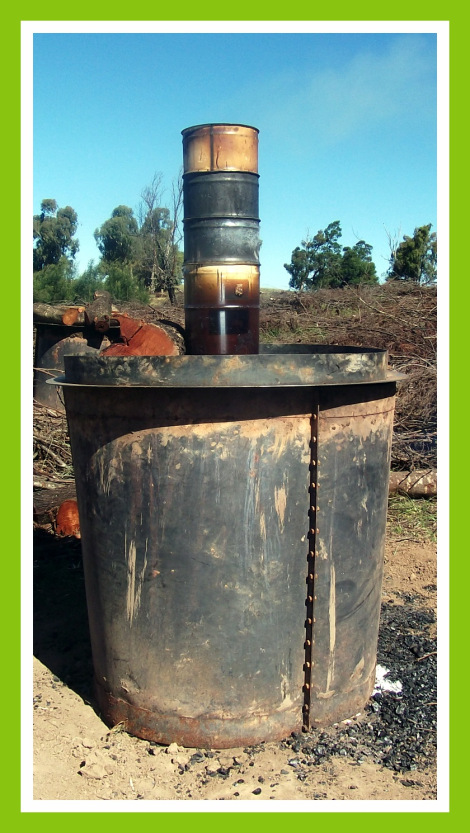
Besides, making 50 kg of char annually, would certainly make a change for the production form a normal sized allotment, certainly so if you go on for several years.

I don't agree that using barrels for making char automatically would imply methane emissions. That must certainly be a consideration depending of the charring method, not the material used.

----------------------------------------
Folke Günther
Kollegievägen 19
224 73 Lund
Sweden
Phone: +46 (0)46 141429
Cell: +46 (0)709 710306
URL: http://www.holon.se/folke
BLOG: http://folkegunther.blogspot.com/


How to Make Charcoal

How to Make Charcoal
Robert Flanagan, SAFFE, January 30, 2008

I've just been playing around with my natural draft stove to see how easy it would be to use it for cooking and making charcoal http://www.youtube.com/watch?v=sZZDtXOiGLE .
I fed some extra fuel in the side so show the pyrolysis reaction taking place.


CHARCOAL (how to make charcoal in a drum)

The author, Gary Gilmore, explains how he designed a charcoal retort from 55 gallon drums. This is a smoke free design also the flare could be put to use. See below link: Charcoal by Gary Gilmore


Charcoal from Smallwood

Charcoal From Smallwood
in "Niche Marketing Strategies for Products from Small-Diameter Timber
A.L. (Tom) Hammett, Professor, Phil Radtke, and Robert L. Smith, Professor and Extension Specialist, Department of Wood Science & Forest Products, Virginia Techi, Blacksburg, VA, Smallwood 2006
Ready for BagReady for Bag


Charcoal Making Videos

Charcoal Making Videos
YouTube, July 2007

SAFFE, Huangzhou, China Renewable Carbon Negative Energy

ioherbalalchemy, USA, Making Charcoal

Making Charcoal in Ivory Coast, West Africa March 18, 2007 ML Murphy


Use the Iwasaki charcoal-making kiln to make charcoal from forest thinnings.

Use the Iwasaki charcoal-making kiln to make charcoal from forest thinnings.
Iwasaki MASATO, Ashikaga Institute of Technology College, Tochigi Prefecture, Japan

The Iwasaki charcoal kiln is made from two steel drum cans.
Since high temperature is used, it takes a very short time to make the charcoal.
Wood (diameter<5cm) charcoal takes less than 5 hours to make.
Bamboo charcoal takes less than 3 hours to make.
This charcoal-making kiln can make be used to make charcoal from corn cobs,


India: Making Charcoal from Prosopis Juliflora

India: Making Charcoal from Prosopis Juliflora
N. Sai Bhaskar Reddy, India April 30, 2007
Prosopis Juliflorai Stacked for Charcoal Making

I had been following terrapreta discussions, which are very interesting.


Chapter 12 - Recovery of by-products from hardwood carbonization

Chapter 12 - Recovery of by-products from hardwood carbonization
in FAO Simple Technologies for Charcoal Making, FAO FORESTRY PAPER 41 FOOD AND AGRICULTURE ORGANIZATION OF THE UNITED NATIONS Rome, 1987


Successful Burn: Making charcoal at 4CN for our experimental study.

Making charcoal at 4CN for our experimental study.
Richard Haard, Larry Williams, Fourth Corner Nursery (4CN), Bellingham, WA April 13, 2007

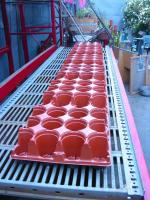
carbon in soil 041


JFBiocarbon Pot Tests May 16, 2007

Date: 05/16/07


Partially burned material a boon to plants

Partially burned material a boon to plants: Sandy (Oregon) resident sees biochar as a way to fertilize and capture carbon
By Garth Guibord, The Gresham Outlook, Mar 30, 2007

When most people see a pile of sticks and wood, all they see is sticks and wood. Sandy resident Paul Elmore, 39, sees possibilities. He sees biochar – burned organic material that can be used to make plants grow.


Syndicate content