Char Research

Effects of Varied Soil Composition (Char, Sand, Potting Mix) on the Growth of Radish Starts

Bear Kaufmann. Initially posted April 7, 2008. Updated August 5, 2008.


IMG_0872


IMG_0878


IMG_0884


IMG_0930


IMG_0934


IMG_0935

Images showing trial preparation and radish germination
(Select image to enlarge in Gallery.)

Materials/Methods

Char was Lazzari Brand mesquite BBQ char (due to availability), crushed and screened to 1/8".
No nutrients were added to the char itself or to the soil.
Soil was FoxFarm OceanForest Potting Soil.
Sand used was horticultural sand.
No mycorrhizal fungi were added.
Mixtures range from 0-100% sand, soil, and char in ~16% increments by volume. 90 pots total. 28 combinations with 3 pots each + 6 additional pots at 33%/33%/33% composition. Pots were placed randomly within the tray. Tray was rotated 180° occasionally.
Plants were watered daily by a drip irrigation system.
Plants were removed from pots ~1 month after first watering. Soil was rinsed from roots and roots were patted dry with a towel. Wet weight of roots+shoots was measured (Acculab VI-3mg, 0.001 g precision).

Box Plots Showing Effect of Composition Across Three Transects
Figure 1. Box Plots Showing Effect of Composition Across Three Transects

Figure 2. Pictures of Radishes at Important Compositions

Results

Plant growth was stunted even for the best preforming plants, likely due to the small pot size. Leaf color varied across different compositions.
A mixture of 33% charcoal and 67% soil had the best growth (176% of pure soil). Aside from mixtures around this level (Figure 1b), high levels of charcoal showed a generally negative effect on plant growth (Figure 1c).

Discussion

The positive interaction effects of charcoal and soil (Figure 1a,1b) are interesting. Assuming charcoal itself provides no integral nutrients to the soil (eg. nitrogen), increasing amounts of charcoal reduce nutrients available from the soil mixture. The effects at 33% char/67% soil, however, show beneficial effects. This could be explained by increased mineralization rates caused by the charcoal causing soil nutrients to be more available to plants. Beyond 33%, the Cation Exchange Capacity of the charcoal may have held the nutrients produced by mineralization, making them less plant available. Since the charcoal was not amended/soaked in a nutrient bearing solution it likely had a low Base Saturationi leading to adsorption of nutrients as they became available. Other potential explanations for increased growth along the soil/char transect include alterations to pH or limiting nutrients (eg potassium(?)) provided by the charcoal. The speculative mineralization/CECii model could also explain the effects seen along the sand/char transect. Here, since the sand lacks organic materials and bound nutrients for soil microorganisms to make plant available, the increasing unsaturated CEC may have made any nutrients less plant available.

Author: Bear Kaufmann bear@ursine-design.com

Terracarbona.com - A New Website for the Promotion of Biochar Research and Experimentation

Terracarbona.com - A New Website for the Promotion of Biochar Research and Experimentation
Chris Braun. February 27, 2008

A new website for the promotion of biochar research and experiments was born !
http://terracarbona.com

You can there discover several biochar-related projects, most of them still in active development . If you are performing biochar soil amendmend trials yourself, your contribution to CharDB or to the Field Trial Portal would be highly appreciated!
And if you haven't done it so far but would like to start experimenting, you can also find useful resources, links and contacts to help you.

This website is still in its infancy and any constructive comment, critic, question, advice... is very important for further development ! For that you can use the devoted forum:
http://z15.invisionfree.com/CharDB/index.php?showforum=2

Thanks for your contribution!

Sincerely yours,
Chris
terracarbona@bionecho.org

Cornell University: Bio-Char Projects 2007

Cornell University: Bio-Char Projects 2007

Bio-char Projects

Currently (January 2007) we conduct experiments to evaluate the effects of bio-char on nutrient adsorption, nutrient leaching, water percolation, soil water availability and carbon cycling as well as the stability and mobility of bio-char itself with research in our Ithaca lab, in Colombia, Brazil, Zambia and Kenya.

Pickens County (GA) Char Research Project (2006)

Pickens County Char Research Project (2006) (Georgia Peanut shell Char)

Cornell - Improving soils with biochar: General considerations and current research efforts

Improving soils with biochar: General considerations and current research efforts
Julie Major, Seminar Presentation, Cornell University, February 22, 2006

9.2 MB Power point presentation, Reduced pdf file (1 MB) attached.

Learning to use wood charcoal in farming

Learning to use wood charcoal in farming at a Northwestern Washington native plant nursery.
Richard Haard, Fourth Corner Nurseries, Washington, Febuary 20, 2007
My motivation for preparing this post is to be able to use this motivate discussion of charcoal as a soil additive. Trying to do this work at a very busy nursery that is perhaps pushing their production factor too high (over 80%) is rather frustrating as experiments have gotten over ruled by planning changes, wiped out by harvest before I can read the data and the conditions set up for the experiment just do not work. However, I have been encouraged however and I am now using hardwood charcoal as a carrier for natural inocculum as a matter of routine.
Fourth Corner Nurseries is a wholesale supplier of native plant species, located on 77 acres in the coastal lowlands of northwestern Washington, USA. With approximately 40 acres under cultivation, we produce two/three million direct-seeded, field-grown, bare-root native plants annually. Our principal crop is individually seed-sourced, bare-root deciduous trees and shrubs, herbaceous perennials, grasses and emergent species such as sedges, cattails and rushes for environmental restoration purposes. Our mission is to sustainably grow plants while supporting workers and their families who depend on the farm for their economic subsistence. Use of surplus biomass from our willow coppice field and other materials is our alternative energy vision.
Aerial view of our farm

Aerial View of Fourth Corner Nurseries

Aerial View of Fourth Corner Nurseries

Richard Haard: Affinity of fungi and crop plant roots to charcoal

Richard Haard: Affinity of fungi and crop plant roots to charcoal
Richard Haard, February 12, 2007

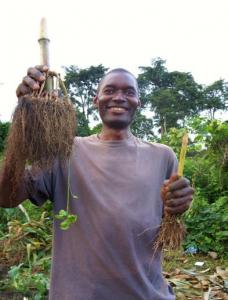
The image below illustrates the affinity of fungi and crop plant roots to charcoal.

Charcoal placed in a fertile garden for a few months showing how crop roots (Swiss chard) and fungi are attached to this medium as habitatCharcoal placed in a fertile garden for a few months showing how crop roots (Swiss chard) and fungi are attached to this medium as habitat

Cornell University Biochar: Work By others

Cornell University Biochar: Work By others
Johannes Lehmann

Bio-char: Research by our Colleagues

Groups that are very active in exploring bio-char as a soil amendment through greenhouse and field experiments (not comprehensive, please excuse any important omissions):

- Marco Rondon: Centro Internacional de Agriculturai Tropical (CIAT), Cali, Colombia

- Bruno Glaser: Institute of Soil Science, University of Bayreuth, Germany

- M. Ogawa: Kansai Research Institute, Japan

Effect of Pyrolysis Char on Corn Growth and Loamy Sand Soil Characteristics.

Effect of Pyrolysis Char on Corn Growth and Loamy Sand Soil Characteristics
Julia Gaskin1, Lawrence Morris2, R.Dewey Lee3, Ryan Adolphson4, Keith Harris4, and K.C. Das4. (1) Univ Georgia, Dept. of Biol. & Ag. Eng, Athens, GA 30602, (2) Warnell School of Forest Resources, Univ of Georgia, Athens, GA 30602, (3) Univ of Georgia, Dept. of Crop & Soil Science, Tifton, GA 31793, (4) Univ of Georgia, Dept. of Biol. & Ag. Eng, Athens, GA 30602

Terra Preta to Bio-char : strengthening links between a model system and practical applications

Terra Preta to Bio-char : strengthening links between a model system and practical applications
Brendan O'Neill, Dept. of Crop and Soil Sciences, Cornell University, NY, February 22, 2006

Syndicate content