USA

Pyrolysis Reactor Tower Assembly

Pyrolysis Reactor Tower Assembly
Sean Barry, April 21, 2008

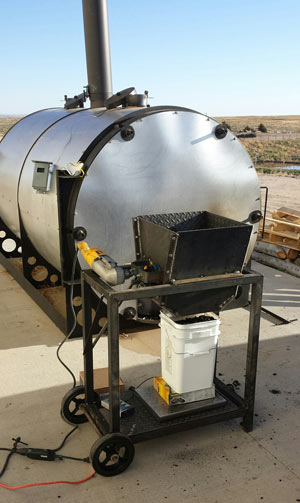
I assembled the Pyrolysis Reactor Tower today. I had it fabricated over the winter.

Regards,

SKB
DSCN0011
DSCN0023
DSCN0033


The Charcoal Vision

The Charcoal Vision: A Win–Win–Win Scenario for Simultaneously Producing Bioenergy, Permanently Sequestering Carbon, while Improving Soil and Water Quality
David Laird, USDAi, ARS, National Soil Tilth Laboratoryi, April 12,2008
In, Agronomy Journal • Volume 100, Issue 1 • 2008

ABSTRACT
Processing biomass through a distributed network of fast pyrolyzers may be a sustainable platform for producing energy from biomass. Fast pyrolyzers thermally transform biomass into bio-oil, syngas, and charcoal. The syngas could provide the energy needs of the pyrolyzer. Bio-oil is an energy raw material (∼17 MJ kg−1) that can be burned to generate heat or shipped to a refinery for processing into transportation fuels. Charcoal could also be used to generate energy; however, application of the charcoal co-product to soils may be key to sustainability. Application of charcoal to soils is hypothesized to increase bio-available water, build soil organic matter, enhance nutrient cycling, lower bulk density, act as a liming agent, and reduce leaching of pesticides and nutrients to surface and ground water. Th e half-life of C in soil charcoal is in excess of 1000 yr. Hence, soil-applied charcoal will make both a lasting contribution to soil quality and C in the charcoal will be removed from the atmosphere and sequestered for millennia. Assuming the United States can annually produce 1.1 × 10⁹ Mg of biomass from harvestable forest and crop lands, national implementation of Th e Charcoal Vision would generate enough bio-oil to displace 1.91 billion barrels
of fossil fuel oil per year or about 25% of the current U.S. annual oil consumption. Th e combined C credit for fossil fuel displacement and permanent sequestration, 363 Tg per year, is 10% of the average annual U.S. emissions of CO2–C.


Effects of Varied Soil Composition (Char, Sand, Potting Mix) on the Growth of Radish Starts

Bear Kaufmann, April 7, 2008

IMG_0872IMG_0878IMG_0884IMG_0930IMG_0934IMG_0935
(Select image to enlarge in Gallery.)

Radish germination was ~one week ago.

Char was mesquite BBQ char (due to availability), crushed and screened to 1/8". Presumably high temp. No nutrients were added to the char itself. No mycorhizal fungi. Mixtures range from 0-100% sand, soil, and char in ~16% increments by volume. 90 pots total. 28 combinations with 3 pots each + 6 additional pots at 33%/33%/33%. Pots are placed randomly in the grid. Radish appears to do much better on pure sand then pure char (which is extreme anyway, the middle range will be more interesting). Plants will be thinned to the two best (of four) per pot this weekend.

Bear Kaufmann

bear@ursine-design.com


Characterization and Thermal Conversion of Charcoal Derived from Fluidized-Bed Fast Pyrolysis Oil Production of Switchgrass

Characterization and Thermal Conversion of Charcoal Derived from Fluidized-Bed Fast Pyrolysis Oil Production of Switchgrass
A. A. Boateng, Industrial Engineering Research, November 8, 2007

Abstract:

The charcoal coproduct associated with pyrolysis oil (bio-oil) production can add economic value to the process operation if it can be successfully employed as an activated biochar for soil amendment applications or can be used as a combustion fuel to power the pyrolysis process or as a gasifier feedstock. Although proposed, none of these have been extensively studied. In this submission, the surfaces and interfaces of the charcoal produced from making pyrolysis oil from switchgrass in a fluidized bed were characterized to establish its usefulness as an adsorbent material. Its reactivity in air and in CO2 were also determined to establish its potential as combustion fuel or gasification feedstock. It was found that the surface areas were low, typically 7.7 and 7.9 m2/g, 2 orders of magnitude of the areas encountered in activated charcoal. Compounding this was high surface crystallinity of the structure as measured by X-ray diffraction, thereby suggesting poor characteristics as a sorption agent without further activation. However, this does not preclude its use for other soil applications including carbon storage and as a nutrient delivery substrate. Upon further pyrolysis in helium, the charcoal yielded equal amounts of CO and CO2, exhibiting reaction kinetics similar to that of coal pyrolysis. Furthermore, reactivity in CO2 and in air atmosphere resulted in activation energies of 8 411 and 11 487 J/mol, respectively. It appears that the charcoal could be better used as combustion fuel or gasification feedstock than as an activated charcoal applied for metal sorption for the fact that the latter application will require higher surface and interfacial areas than measured.

Ind. Eng. Chem. Res., ASAP Article 10.1021/ie071054l S0888-5885(07)01054-8
Web Release Date: November 8, 2007


Growing plants with charcoal

Growing plants with charcoal
Richard Haard, Fourth Corner Nurseries, Bellingham, WA, June 27, 2007
[G2:709]
Select image to enlarge
This is an image of our charcoal as soil additive study at our nursery. Shown is one of our test subjects a local native shrub that we propagate and sell for riparian restoration projects. Black Twinberry, Lonicera involucratai. This plant was a 2 year old seedling, bareroot harvested and stems clipped to 6 inches before planting in the test bed 7 weeks ago.


Azotobacter Question and Answer June 2007

Azotobacteri Question and Answer June 2007
Richard Haard, Four Courner Nursery, Bellingham, Washington, June 11, 2007

Question by Sean Barry:
RH ". . .Learning about potential for enrichment culture of Azotobacter and trying to measure available nitrogen in this situation."

Here you mention promoting the growth of nitrogen fixing Azotobacter. I have always been interested in the possibility of inoculating charcoal with mycorrhizal fungi.


Fourth USDA Greenhouse Gas Conference: Positioning Agriculture and Forestry to Meet the Challenges of Climate Change

Fourth USDA Greenhouse Gas Conference: Positioning Agriculture and Forestry to Meet the Challenges of Climate Change
February 6 - 8, 2007 - Baltimore Marriott Camden Yards, Baltimore, Maryland

Conference Program

13: Soil Carbon: Part I - Interactive Discussion


Special Report: Inspired by Ancient Amazonians, a Plan to Convert Trash into Environmental Treasure

Special Report: Inspired by Ancient Amazonians, a Plan to Convert Trash into Environmental Treasure
Anne Casselman, Scientific American.com, In Focus May 15, 2007

New bill in U.S. Senate will advocate adoption of "agrichar" method that could lessen our dependence on fossil fuel and help avert global warming


Charcoal Experimental Plots

Charcoal Experimental Plots
Rich Haard and Larry Williams at Fourth Corner Nurseries, Bellingham, Washington, May 6, 2007
[G2:366]


Successful Burn: Making charcoal at 4CN for our experimental study.

Making charcoal at 4CN for our experimental study.
Richard Haard, Larry Williams, Fourth Corner Nursery (4CN), Bellingham, WA April 13, 2007

carbon in soil 041


JFBiocarbon Pot Tests May 16, 2007

Date: 05/16/07


Syndicate content