Williams
Charcoal in agriculture: Experimental research at Fourth Corner Nurseries
Richard Haard, Fourth Corner Nurseries, Bellingham, Washington, January 3, 2008
Greetings
I just finished over the last few days organizing images and data from my charcoal experimental plots. I am presenting a new set of posters showing root systems of the native shrub, Lonicera involucrata or black twinberry that I used as an experimental subject in these treatment plots this summer.
This will be the last of a series of piecemeal postings about my findings on the terrapreta reading list. In time, I will prepare a summary of what I have accomplished this year, the shortcomings, what I feel I have learned from this work about using charcoal and my plans for continuing this experiment for 2 or more growing seasons.
Quick background - my employer, Fourth Corner Nurseries is a bare root native plant nursery. We grow more than 350 kinds of plants for environmental restoration and landscaping purposes. Our farm is 60 acres in 2 fields. Shown here is our east field. Formerly, I have been trying charcoal as a soil additive for several years and this season I attempted a controlled experiment. It did not go without a hitch.
What I established this year was a series of 28 - 17 foot long treatment blocks that are a pair of treatment sets consisting of untreated soil, charcoal only, fertilizer only compost only and combinations of charcoal, compost, fertilizer. In each treatment block 3 kinds of plants were installed: a native shrub, Lonicera; a native perennial - Aster subspicatus; and a vegetable - swiss Chard.
All were selected for their heavy nitrogen consumers and all production was removed from the plots, roots and tops, then the plots replanted and cropped again without further fertilizer, compost or charcoal.
The most detailed measurements accomplished this year is 2 sets of soil chemical analysis completed at a University laboratory. Plant response measurements this year, for several reasons was only visual observation. This set of posters I am presenting today shows subtle but interesting and positive additive effects of compost and charcoal.
Further analysis will be presented at a later date.
How it went. Early April while the plants were still dormant I took 2 year old bareroot Lonicera seedlings trimmed tops and roots and planted in peat/perlite mix in 4X4 inch containers. At these same time I planted
sprigs of Aster in the same manor. After the plants had firmly rooted into the containers and our field soil had warmed, I prepared a growing bed in our normal propagation field ( Field 13, row 8). The growing bed is about 4
feet wide and 500 feet long. I divided this into 17 foot beds with separate treatments in a systematic way. Here is charcoal 1, a fine powder that was donated by JF Waste energy systems. Here is charcoal 2 a lump and powder mix that
Larry Williams and I made with a top draft earth covered mound. I am using the lump charcoal because I can observe microbe utilization over time as Larry has been studying for several years.
Here are the charcoal test beds are they appeared before rototilling. In this image furthest is compost only, then compost/charcoal1,then compost/charcoal2,then compost/charcoal 1/fertilizer and so on in a systematic pattern repeating again in a second duplicate set on the north end of the field. In discussing these tests I sometimes discuss each set separately, are are called south set and north set.
Here are the plots immediately after rototilling. Note that the charcoal does not appear to be uniformly dispersed. After harvest with the
lifter-shaker charcoal is better mixed in the soil. Each bed received about 30 gallons of charcoal. Fertilizer and Compost were applied at rates normal for our farming practices.
We planted the plots in mid May and by late June they looked like this and this and this .
By the end of August the Swiss
Chard had matured and we had our first harvest. Yields were impressive but no trends specific to treatments were noticed.
Here you can see our plot method for measuring yields of swiss chard and also how the separate treatments, Lonicera, Aster and swiss chard have grown together making assessment of total production rather difficult.
In late October I conducted a survey of the Lonicera component of the research plots. It was the end of the growing season but before the frost defoliated the plants.
Here is how the plots looked. My first look at the data that showed a subtle but encouraging trend of improvement from the use of charcoal 1.
In this set of images notice that the treatments with compost when combined with charcoal tended to be larger.
The same trend is also noticed in the compost/fertilizer/charcoal combinations. By mid November we were ready
to lift all the plant material from the plots, examine the roots and fall replant with a single species crop for next year. Here we have our lifter shaker harvesting the plants, Lonicera with charcoal staining roots and Rena picking up the plants. Later we replanted with our 4
row seeder and reseeding with another native shrub species, Oemleria cerasiformis, chosen because it too is an agressive nitrogen consumer.
Finally the posters I have prepared to compare top growth and root growth in each of the treatment sets. I have organized the images according to groups of treatments as follows: The links are to the larger size images for better viewing. Edit note root images were created 11/15 not 10/25
First Groups 1 and 2 the control sets that received no treatment or had charcoal only
Roots
Field View
Next Groups 3 and 4 fertilizer sets Edit Roots is labeled as Groups 1 and 2
Roots
Field
View
Next Group 5 South end plots compost set
Roots
Field
View
Next Group 6 North end plots compost set
Roots
Field
View
I think these findings will be encouraging information for John Flotvik and many thanks for his donation of charcoal from his pyrolyser and thanks again to Larry Williams , his thoughtful work and helping when it is most needed.
I am looking forward to another season of data from this set of test plots. Comments, ideas, criticism, discussion whatever are appreciated as I am now preparing my season end report.
Richard Haard, Fourth Corner Nurseries, Bellingham,Washington.
Copyright January 3, 2008
Permission for distribution of these materials and images is granted for entire text and images only so long as the author and initial place of publication;"http://terrapreta.bioenergylists.org/" is
cited. Individual images may be used by permission only from author.
Biochar Trials at Fourth Corner Nursery
Richard Haard, Fourth Corner Nursery, Bellingham, WA, December 6, 2007
Hello All - For your interest
I submitted to Tom for posting [attached] some initial soil analysis data from my charcoal block study. In am just beginning to compile a report on this work. When it is posted you will see soil analysis results averaged for each replication(2) for 2 dates , April and October. Listed are pH, Buffer pH, OM, Nitrate, Cation Exchange Capacity (CEC) and base exchange components, % Potassium, % Magnesium, % Calcium. Other soil analysis was taken but not presented here.
Keep in mind this is a 2 to 3 year study and no additional additions or treatments will be done other than continuous cropping and harvest of all growth, tops and roots, at our bare-root native plant nursery. It is my attempt to emulate Christoph Steiner, et al research in Manaus
Long term Effects of manure, charcoal and mineral fertilization on crop production and fertility on a highly weathered Central Amazonian upland soil
http://terrapreta.bioenergylists.org/node/442
Our test was compost, charcoal (two sources) mineral fertilization and control and permutations as was done in experiment above. We're in the moist mild climate of the Pacific NW, USA on a sandy loam soil. It naturally carries very high levels of potassium and calcium found also in unfarmed soil.
I have never tried this kind of intensive soil testing before and am still learning about season to season changes and how to interpet the data. I am working now on photosets taken at harvest time and these will be posted as well as a concise statement on the experiment terms and what I think the results represent.
Rich Haard -
And thanks to Larry Williams for his work with me on this project and his critical comments.
Charcoal Experimental Plots
Rich Haard and Larry Williams at Fourth Corner Nurseries, Bellingham, Washington, May 6, 2007
[G2:366]
Successful Burn: Making charcoal at 4CN for our experimental study.
Making charcoal at 4CN for our experimental study.
Richard Haard, Larry Williams, Fourth Corner Nursery (4CN), Bellingham, WA April 13, 2007
[G2:203]
Charcoal Making at the Fourth Corner Nurseries.
Charcoal Making
Rich Haard, Fourth Corner Nursery, Bellingham , Washington, March 31, 2007
Terrapreta interest group
Here is a set of images about our charcoal making project this weekend. It is a smothered pit method, first time for myself . We did open the lower end of the pit after 5 hours and take out about 40 gallons , then we put the unburned wood back in and recovered. We will be looking at it again in about 18 hours.
Richard Haard: Affinity of fungi and crop plant roots to charcoal
Richard Haard, February 12, 2007
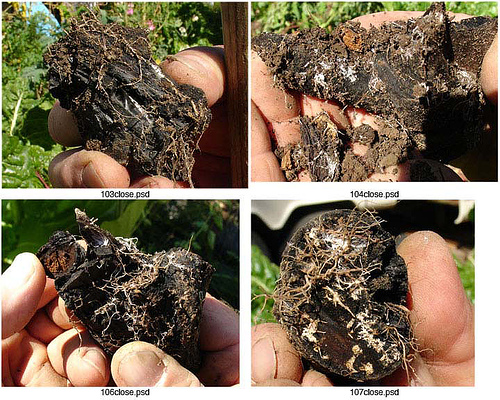
The image below illustrates the affinity of fungi and crop plant roots to charcoal.