Charcoal

Gardening with Biochar FAQ (Wiki)

Gardening with Biochar FAQ (Wiki)
Philip Small, May 21, 2008

Welcome to a Gardening with Biochar FAQ!
... a work in progress...

When gardeners add biochar to garden soil, we are, in effect attempting to follow in the footsteps of the originators of Terra Preta. Because we don't know exactly how that process worked, nor how we can best adapt it outside its area of origin, we are left to discover much of this by experimenting with our own gardens and comparing observations within our own communities.

See:

Gardening with Biochar FAQ (Wiki)


More Trials

More Trials
Max Henderson,May 12, 2008

If you can bear with me here is some info from last weekend’s
trials. Various conclusions are probably of little scientific merit and may well be blindingly obvious but I’ll include for those who maybe don’t have one of these exciting toys.


  1. The original second–hand house brick kiln had 15cm/6” (when will the US
    join the rest of the world?) gaps between the drum and the bricks on both
    sides, and a relatively shallow space under the drum for the initial fire.
    The idea was that it would be easier to add fuelwood on the sides, but in
    fact this reduced the effectiveness of the insulation.
  2. I re-laid the bricks to give a greater fire space under the drum for the
    initial fire, and moved the side walls inwards so that the only gap was
    between the ridges of the drum and the bricks. The basic concept was to
    apply the heat from underneath, and to insulate as best possible (under
    the primitive circumstances) against any unnecessary heat losses
  3. The drum was loaded with around 100kg of old dry dense hardwood, plus 2 x 75mm
    thick telephone books and some tyre scraps I had collected from beside the
    highway.
  4. Scrap dry wood was loaded under the drum and fired at 17:00. Once that achieved
    a significant burn I added bricks to the open front to further improve
    insulation
  5. I’ve learnt that a slow initial burn is best as opposed to a blast. The
    assumption here is that the mass of material in the drum (despite MC of
    maybe less than 12%), needs gradual heat (given the substantial insulating
    properties of dry dense wood) well before the stage when pyrolisis can
    begin and be sustained. I’ve done the opposite –high initial heat, quick
    gasification, and then no continuation. There is a lot to discuss here,
    including the use of ‘waste’ heat to raise the temp and reduce MC, in the
    following batch.
  6. By 18:00 the first gas burn had started and by 18:15 the 8 x 8mm holes in the
    base of the drum were all roaring
  7. This was about the 10th trial, and with each the seal on the drum
    lid has become less effective. This photo shows the burn of the escaping
    gases through these leaks. In a totally un-scientific guess I’d suggest
    that at least a litre of gas/second was burning happily through the gaps.
    None of this energy was in any way contributing to the char process. These
    waste gases burnt for 2 hours.


  1. With all the jets alight I then added bricks to the top of the drum, giving
    better insulation.

  1. By 19:00 the drum was glowing red hot when seen through the gaps in the top
    bricks, except for a small strip down the centre of the top. I dropped
    some glass from a broken bottle in a couple of the gaps, and within
    minutes the glass became malleable.
  2. Around 21:00 the gas burn started to slow down, and by 22:00 the last flame was
    gone.
  3. The front bricks were removed at dawn, and by midday the drum was cool enough
    to be opened without a risk of the char catching alight.

  1. The
    charring was complete, including the tyre rubber, the 2 phone books, and
    dense hardwood as large as 20cm/8” in diameter.
  2. Volume
    loss was in the region of 20% at a guess.


It is the energy output that continues to stun me. The
volume of gas that escaped through the poor lid seal was very substantial and
burnt for over 2 hours. In addition, the gas burning under the drum was
obviously far in excess of the volume required to maintain the char process,
just using the red heat of the drum as an indicator. And on top of that was the
vast heat energy given off to the atmosphere despite the attempts to provide
insulation.


I’ll continue making batches using this crude system
every weekend, but there’s not a lot more to prove and I now really need to
take the lessons learnt and build a decent drum and kiln. In particular the
effectiveness of the insulation will be a considerable determinant in the efficiency
of the process. I will aim for a castable refractory kiln in a similar shape to
the current brick one, with relatively narrow gaps between the drum and the
refractory except for the “firebox” underneath. It will have two hinged doors
at the front – the upper one allowing the drum to be slid out above the lower
firebox door. A similar upper door also for the rear, and this will also have
an adjustable vent to allow heat to escape rearwards. This would lead into a
second chamber where another drum loaded with wood is waiting its turn in the
queue, being pre-heated at the same time. When one drum has completed the char
process, it will be slid out to cool, the drum in the heat chamber at the rear
is slid in to take its place, the refractory is at high temp already, the gas
jets are lit, doors closed, the third drum is loaded and slid into the warming
chamber….


The drums to be fabricated from boiler plate, and
maybe with domed lids and toggle screws to clamp down. Then I need to work out
how to plug in a pipe or hose to vent off excess gas, plus a compressor and a
pressure vessel to store. And that pre-supposes a capacity to record
temperatures inside the drum so that this info can be fed to a controller that
will make decisions when and if to pipe off some gas for storage. Plus a
serious gas burner system under the drum, because I believe we can eliminate
the need for wood fuel and just use some of the stored excess gas. And then
some boiler tube at an upper level through which water can be piped and fed into
a large storage tank as a heat bank, and then into the house and/or a
greenhouse in winter through sub-floor piping, radiators, or a concrete storage
tank under the slab. I don’t have a house at the farm yet or even a greenhouse
much less an electricity supply but that just adds some more interesting
challenges. Its down to time and dollar availability.


In the meantime I’m continuing with the garden trials,
and certainly there is visible evidence of improved growth and vigour in the
plots which had the char added. The best is the one that also had some cocopeat
organic matter added, as well as some worm castings. Digging down a few inches
and grabbing a handful gives this sweet-smelling crumbly mix, laden with
organic matter and just seeming to be bursting with goodness. Hardly a
scientific analysis but I’ve been handling and smelling soil for a long time
and this lot is just about good enough to eat.


Max H


Agrichar Video

Agrichar Video
Australian Broadcasting Corporation, 2007

Video on Agrichar, International Agrichar Initiative conference (April 2007), BEST Technologies, and use of agrichar in Australia.

http://www.abc.net.au/science/broadband/catalyst/asx/Agrichar_hi.asx


Simple charcoal kiln

Simple charcoal kiln
Folke Gunther, April 24, 2008

A wonderfully simple method for making charcoal at home or on the allotment.

"http://picasaweb.google.se/folkeg/TheSimplestOfTheSimple

--

There is a wide demand for charcoal kilns to be used by anybody having an allotment or garden sized plot. The idea of making char of surplus biomass instead of firing it is widely spread in Latin America (and Japan?). Burning the pyrolysis gasses instead of emitting them makes the method comparatively safe, although not efficient regarding their potential utilisation of gasses.

I agree that his is a very small scale method, bu imagine 2 billion people having it, making 1 kg char a week for their lots. That would imply about 0.1 Gt annually, or 5% of what would be necessary to sequester for making a change.

Naturally, this is not the method to save the world from entering a tipping point, but it could well be of some help.

Besides, making 50 kg of char annually, would certainly make a change for the production form a normal sized allotment, certainly so if you go on for several years.

I don't agree that using barrels for making char automatically would imply methane emissions. That must certainly be a consideration depending of the charring method, not the material used.

----------------------------------------
Folke Günther
Kollegievägen 19
224 73 Lund
Sweden
Phone: +46 (0)46 141429
Cell: +46 (0)709 710306
URL: http://www.holon.se/folke
BLOG: http://folkegunther.blogspot.com/


Sewage Sludge Charcoal

Sewage Sludge Charcoal
Michael Antal,University of Hawaii, April 2008
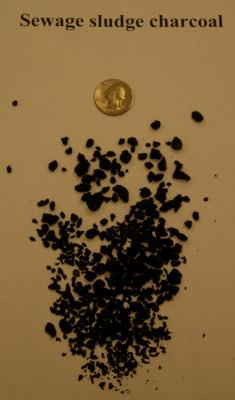
Sewage Sludge CharcoalSewage Sludge Charcoal
I am pleased and somewhat surprised to report that raw sewage sludge is a good feedstock for charcoal production. Details are available on the HNEI website below.

www.hnei.hawaii.edu
Flash Carbonization

Regards, Michael.

Michael J. Antal, Jr.
Coral Industries Distinguished Professor of Renewable Energy Resources
Hawaii Natural Energy Institute
POST 109, 1680 East-West Rd.
Honolulu, HI 96822

phone: 808/956-7267
fax: 808/956-2336
www.hnei.hawaii.edu


Improving wheat production with deep banded Oil Mallee Charcoal in Western Australia

Improving wheat production with deep banded Oil Malleei Charcoal in Western Australia
Paul Blackwell1, Syd Shea2, Paul Storer3, Zakaria Solaiman4, Mike Kerkmans5, and Ian Stanley6
Agchar Initiative Conference Terrigal New South Wales. April 29 - May 2, 2007

SUMMARY
• There can be benefits to wheat income from deep banded oil mallee charcoal in the low rainfall areas of WA; the trials on acid sandy clay loam and acid sand in 2005 showed up to $96/ha additional gross income at wheat prices of $150/ha; especially when applied with mineral fertilisers and inoculated soil microbes. Much of the yield improvement can be explained by better grain survival, associated with reduced drought stress.

• There were encouraging effects of charcoal on arbuscular mycorrhiza (AM) colonisation. Banded oil mallee charcoal improved AM colonisation of wheat roots by 3 fold, when used with mineral fertilisers and AM is inoculated with the seed in the acid sandy clay loam with a low population of indigenous AM. Early phosphorus uptake was not improved by AM colonisation; P supply from the soil and applied fertiliser was already adequate.

• AM colonisation in spring was related to effects of charcoal application on grain survival in inoculated mineral fertiliser treatments. This infers AM hyphae may have improved water supply to reduce drought stress and loss of grains in these treatments.

• The true economic value of oil mallee charcoal will be clearer when the cost of charcoal production and application is better known and long term effects of charcoal, especially with inoculated AMs and mineral fertilisers is better understood. The potential to achieve a commercial return from the sequestration of charcoal as an offset for carbon
dioxide emissions in broadscale agriculture will also help calculate true economic value.

• More research is worthwhile on the long term effects of incorporated charcoal in a range of soil conditions and seasons, from various sources and how low the banded charcoal rate needs to be to encourage better yields from mineral fertiliser with inoculated AM.

INTRODUCTION
Oil Mallees are the first native woody perennial species to be promoted as a commercial crop in the lower rainfall areas of the southwest land division of Western Australia, primarily stimulated by the need to ameliorate salinity caused by the clearing of native vegetation for agriculture (Bartle and Shea, 2002). Mallees are hardy plants that are well suited as a perennial crop through their ability to re-sprout from the large lignotuber after the above
ground mass has been lost through fire or harvesting. In 2000 a group of Oil Mallee growers from Kalannie (300 km NE of Perth, Western Australia) began producing eucalyptus oil for the Australian market (see the Oil Mallee Association www.oilmallee.com.au ). Integrated processing of mallee biomass to produce electricity, activated carbon and eucalyptus oil in a central processing facility has been the main emphasis of industry development since the late 1990’s. Western Power, Enecon and the Oil Mallee Company have successfully developed a ‘test of concept’ Integrated Wood Processing (IWP) plant at Narrogin. Bell and Bennett (2002) estimated that the NPV of the net benefit to landowners of planting mallees in a local catchment area to supply a 5MW IWP would be about $6.2 million over 20 years. Charcoal is a valuable by-product of such IWPs and a possible by-product of farm based distillation of eucalyptus oil.

It has become well recognised in Japan and some other parts of Asia that charcoal from forestry products and rice hull can stimulate indigenous soil microbial activity (Ogawa, 1994; Nishio, 1996). Charcoal has especially encouraged arbuscular mycorrhiza (AM) which can help supply phosphorus symbiotically to many agricultural crops (Ogawa et al., 1983) and rhizobia, which can fix nitrogen from the atmosphere to supply leguminous plants (Nishio and Okano, 1991). Field experiments in Indonesia (Yamato et al. 2006) showed charcoal made from tree bark applied at 10 L/ha could increase the yield of maize by about 50%, to 15 t/ha, when added to 500 kg/ha of NPK (15:15:15) fertiliser on an acid highly weathered infertile tropical soil; associated with increased AM fungal colonisation. Lehmann and Rondon (2006)
also identify numerous benefits of bio char to plant nutrition and microbial activity in the humid tropics. Benefits of charcoal to soil microbial activity have also been recognised in temperate forest environments (Zakrisson et al. 1996; Pietikainen et al. 2000).

Charcoal seems to assist microbial activity by having a porosity that provides a favourable microhabitat, weak alkalinity and by being a substrate unfavourable for saprophytes (Saito and Marumoto, 2002). AM fungi easily extend their extraradical hyphae into charcoal buried in the soil and sporulate in the particles (Ogawa, 1987). Postma et al. (1990) show evidence that rhizobia in pores <50 _m are protected from predation by protozoan predators; this
could be an important microhabitat property provided by charcoal in soils with low clay content.

Encouragement and establishment of AM fungi in Western Australian soils has encountered many challenges. “The objective of identifying procedure for managing mycorrhizal fungi is more appropriately restated as managing conditions to suit the growth and activity of beneficial populations of mycorrhizal fungi” (Abbot and Gazey, 1994). Introduced AM fungi can suffer competition with indigenous AM fungi and be ineffective for crop phosphorus supply due to high levels of background soluble P (Gazey et al. 2004). Australian native grass species can also be much more efficient at accessing insoluble forms of phosphate than introduced wheat varieties; whose rhizosphere colonies can be very different (Marschner et al. 2006). This may be an adaptation to the low clay content environment of many Australian topsoils; low clay content reduces the amount of small pore space to help some microorganisms prosper. Charcoal in suitable amount and form may provide the missing microhabitat in WA topsoils to help introduced AM fungi and other microbes survive and colonise introduced agricultural crops.

One commercial fertiliser company (Western Mineral Fertilisers; Tenterden WA) has developed products which minimise the abundance of readily soluble phosphorus to encourage symbiotic and other processes of inoculated soil microbes. Zeolite was initially included and intended to provide enhanced ion exchange capacity, and also a micro habitat
within the zeolite pores; however the pore volume may not be sufficient. It was a reasonable hypothesis that charcoal addition may improve the microhabitat further than the use of zeolite.

The opportunity to test hypotheses about charcoal effects on soil and use of soil microbes to improve crop nutrient supply came about in 2005. There was an intensive research effort to examine the efficacy of very wide rows of wheat on shallow soils in the low rainfall areas east of Geraldton (Blackwell et al. 2006; Blackwell 2007). With some support and encouragement from the Oil Mallee Company and Western Mineral fertilisers we developed the following experiments using no-till methods for crop establishment and very wide rows to minimise drought stress. Attempts to follow the long-term effects at Pindar failed due to a very dry winter season in 2006.

See complete paper attached and at:http://www.oilmallee.com.au/pdf/Improving_wheat_prod.pdf
See oral presentation at:
http://www.iaiconference.org/images/Blackwell_-_Improving_Wheat_Production_with_Mallee_Charcoal.pdf

1Department of Agriculture and Food, Geraldton WA, 2 Oil Mallee Company of Australia, 3Western Mineral
Fertilisers, 4University of Western Australia, School of Earth and Geographical Sciences, 5Oil Mallee
Association of WA, 6 "Bungadale", Kalannie , WA


Jatta Charcoal Retort, The Gambia

Jatta Charcoal Retort, The Gambia
Bakary Jatta, Bwiam Villiage, The Gambia, March 27,2008
Jatta RetortJatta Retort

My retort is in my back yard. It is a drum with a fairly tight lid and a piece of pipe letting volatile gasses take over the initial firing in the firebox underneath. The drum is enclosed in a rock and soil and lime plaster wall. For a quick start I surrounded the drum with small branches or crop waste before covering the top with a scrap iron sheet with a gap for smoke to escape in the beginning. The drum costs money, the rest is labor.

The biomass is crop waste and or tree trimmings. Some material is up to 50 mm thick and still chars all through. Like was stated on the list, the char appears to be about 40 %. After initial smoke, the volatiles take over and burn with a roaring sound. Sorry, no analysis of the off gasses, but I trust I am not a poluter beyond the normal CO2. With adequate investment the excess gas or heat can be utilized, not likely an easy option for most third world farmers.

Where does all the biomass come from? Plant it! People still get rid of lots of it to clear roadsides and farms here. OTOH, I am planting more biomass every year and my soil is improving in the process. My mini climate is improving too as many of the trees retain their leaves during the dry season . Jatropha curcass is a soil improver and wind break. Not useful for char, but it makes great fuel oil for lamps and soap making. The oil cake makes good methane gas for cooking. The digester effluent is mixed with the bio char before it put in the planting holes on the field. Soil improver, energy and soil micro-organism inoculant.

Is it economic? What is the meaning of that? Maybe, when I get a good harvest, which depends on many other factors, like rain, etc. After all, food prices are going up because of increasing scarcity. Maybe some people think they can eat their economic gain in the form of money. During the last world war money could not buy food that was not there! You think the government is going to regulate food production to assure economic gain and sustainability? Or the market place will be regulating the climate in a timely fashion so that harvests will be reliable. My conclusion is that the real value is the food and other resources provided by the life of the plant springing from the soil.

Why am I doing this? I think it is a usefull thing to do. There was a quotation that I recognized as true: 'The Spritual precedes the material'

The economic consideration will not bring a solution. It has in fact been the cause of the problem!

So, considering economic criteria, maybe no present value seen yet , but the net value will be having a future worth having at all. It is a choice and it better be a collective choice. If it does not do all as expected, do we lose anything?

Kind regards,

Bakary Jatta

Bwiam village, WR

The Gambia


Bamboo-based Charcoal Production

Bamboo-based Charcoal Production
National Mission on Bamboo Applications, InfoSheet IS 03 09/05, India

Charcoal made from bamboo finds ready uses and markets. It has been made for thousands of years in pits and even shallow depressions. Specially designed brick kilns, developed and tested by the National Mission on Bamboo Applications (NMBAi), provide an opportunity to make high-quality charcoal from bamboo in an efficient, safe and reliable manner.

National Mission on Bamboo Applications (NMBA)
Vishwakarma Bhawan, Shaheed Jeet Singh Marg
New Delhi 110 016, India
Telephone 91-11-26566778 Fax 91-11-26962267
Email bamboo@bambootech.org
Website www.bambootech.org


Charcoal and Salicylic Acid

Charcoal and Salicylic Acidi
Nikolaus Foidl, Bolivia, February 6, 2008

Dear All , some photos.
First the difference between Charcoal and non Charcoal was nearly 60 cm in height, then after correcting soil minerals and applying Salicylic acid the difference vanished and the plants started really to grow.The maize started to get up to 5 cobs build on every shank in every axle. Could harvest now up to 4 fully developed cobs per plant in the no charcoal and in the charcoal plot. No measurable difference between the two areas.Will repeat those trials to get to the bottom of it.This time will mill and extract with different acids all minerals from the charcoal prior to the introduction to the soil to see if there is still some growth enhancing effect left in the first stage.( without adding salisylic acid.) Best regards Nikolaus
Select Image to Enlarge
DSC00683.jpg

DSC00686.jpg

DSC00825.jpg

DSC01197.jpg

DSC01235.jpg

DSC01376_001.jpg

DSC01389_001.jpg

DSC01195.jpg

DSC01376_001.jpg

DSC01389_001.jpg

DSC01392.jpg

DSC01423.jpg

DSC01442.jpg

DSC01452.jpg


Effects of Charcoal on Manure in a Temperate Forest Ecosystem: A Greenhouse Study

Effects of Charcoal on Manure in a Temperate Forest Ecosystem: A Greenhouse Study
Clarice Pina, Project Train 2005, University of Montana, 2005 with Tom Deluca.

http://www.umt.edu/projecttrain/posters/2005%20Posters/Clarice%20Pina.ppt

Abstract
A greenhouse study was conducted for and eight week period studying the effects of charcoal on manure within a temperate forest ecosystem. Charcoal posses properties that lead us to devise the creation of a unique synergy between manure and charcoal, a land use treatment used in ancient Amazonia. A negative effect was observed with respect to overall biomass per treatment caused by manure application but this effect was eliminated with the addition of charcoal. Manure significantly increased the amount of available phosphorus. Fresh manure may have cause a microbial inhibition to occur yielding unexpected results with ammonium and nitrate concentrations. Altering the rates of both manure and charcoal may help us to locate the source of these unexpected results.

Results:
Salient findings:
Additions of charcoal and manure individually did not have a significant effect on the amount of available NH4+, but the Manuchar treatments were found to have a moderately significant effect on available NH4+ (refer to Figure 1).
All treatments (charcoal only, manure only, as well as manuchar) have a highly significant effect on the amount of available NO3- (refer to Figure 2).
Manure significantly decreased the total amount of NO3-.
With regard to the amount of available P, the manure only treatment had the greatest concentration measured as mg kg-1 PO4-.
Manure applications had a very highly significantly effect, increasing the amount of available-P by almost a factor of 2(refer to Figure 3).
Manuchar treatments were also found to have a highly significant effect on the amount of available-P.
Significant differences were found between treatments with regard to biomass obtained, and manure applications were found to have a negative effect on biomass (refer to Figure 4).


Syndicate content